
July 1, 2026
Dukem, June 8, 2018 (From Melmi)
After food and clothing, shelter is one of the basic needs of humans. The government is carrying out a variety of housing development options and technologies to increase the provision of housing, which is a basic need.
One of these solutions is to accelerate the construction of prefab technology home development, which is one of the desired results. This makes it appropriate to build houses that can be assembled in a short time to improve the provision of housing for the growing segment of the society.
Houses built with these prefabricated building elements use a lot of local resources; prevent waste and pollution; are cost-effective and consider the ability of citizens to pay, and they allow for the training of professionals in a short time. One of these solution options is prefab technology.
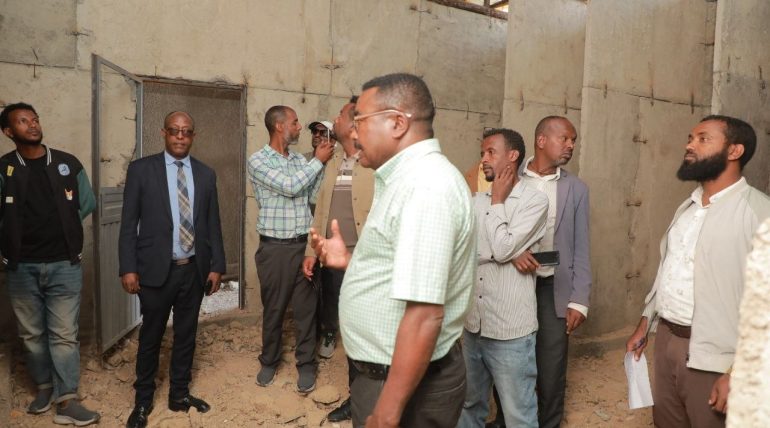
In this regard, the construction of a 48-room house built using prefab technology at the entrance of Dukem city, prepared by the Chief Executive of the Construction Industry Development Department of the Ministry of Urban Development and Infrastructure, is an example of this.
Following the recent corridor development in various cities in Ethiopia to improve the living standards of rural residents, the prefab technology being implemented in the rural corridor, which is one of the projects being carried out to improve the living standards of rural residents, has introduced a method of building a house made of only fiber, gravel, sand and cement, unlike the more well-known houses built with steel, cement and blocks.
Eng. Birhanu Kassa, who brought the technology to Ethiopia, said during the visit that the prefab technology, which was patented 8 years ago, is currently a standard and is being widely used in our country’s cities and rural kebeles, and efforts are being made to expand the opportunities for the technology to be widely used.
The participants of the visit expressed their satisfaction with what they saw, as the technology has been tested in practice and is being widely used. They suggested that the technology should be expanded and improvements should be made regularly as it is developing; that there should be a separate manufacturing facility for the building body; that there should be a situation where laboratory testing can be ensured; that there should be market linkages; that there should be opportunities for joint work and that conditions should be created to work in coordination with established associations in the sector.
