
October 13, 2026
Adama; September 17, 2019
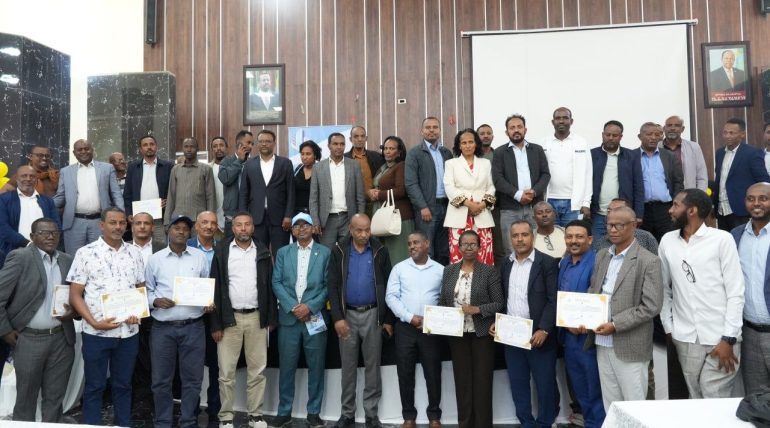
The Urban Revenue Reform Project Office under the Ministry of Urban and Infrastructure held a closing ceremony for the 8th round of training and assessment conducted during the 2018 fiscal year. This initiative, carried out across five universities (Ambo, Adama, Bahir Dar, Dire Dawa, and Hawassa), aimed to build the capacity of professionals in urban planning, land management, and urban finance, thereby enabling them to provide superior, high-quality services to residents.
Abebe Feleke, representative of the Project Office’s Director General, opened the event by stating that the training and assessment were designed to enhance the effectiveness of urban administration, boost the implementation capacity of municipal bodies, and ensure public satisfaction through the realization of good governance. He further noted that tangible results have been achieved through these multifaceted human resource development efforts. In his concluding remarks, he called upon officials to establish robust operational systems to support the deployment of professionals—who have completed vocational training and passed assessments—to positions that align with their specific fields of expertise, thereby enabling them to apply their knowledge to public service.
Mr. Maksud Kheiru, Coordinator of the Capacity Building and Communication Unit at the Project Office, presented a report on the training and assessment conducted during the 2018 fiscal year. He noted that the training covered five key streams—Cadastral Surveying, Cadastral Registry, Urban Planning, Real Property Valuation, and Urban Finance—spanning vocational levels two through five. He further highlighted that the resulting knowledge transfer has been instrumental in realizing workforce development goals and achieving the desired outcomes.
Federal and regional officials, university administrators, and participants of the training and assessment program attended the event.
Based on the presented report, a joint discussion was held regarding priority areas for the training scheduled for the 2019 fiscal year, and future directions were outlined. Certificates of appreciation and recognition were also awarded to the institutions that contributed to the success of the training and assessment activities.
Send feedback
